Matbucha: The Slow-Cooked Moroccan Jewish Tomato and Pepper Salad Everyone Is Rediscovering
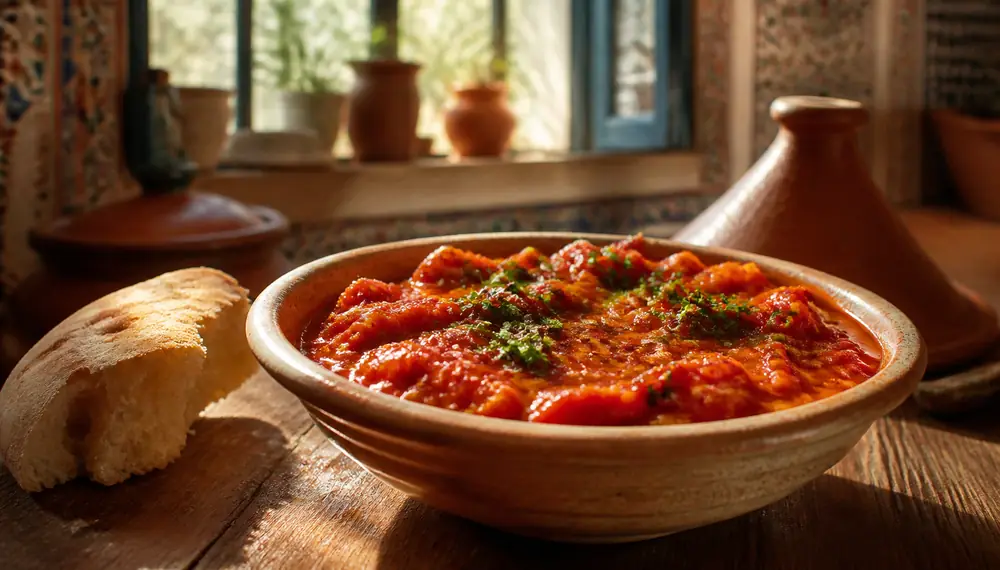
There is a moment in every Moroccan Jewish kitchen, usually late on a Thursday, when the whole house smells of tomatoes surrendering. Not simmering — surrendering. Two hours into the pot, the water has gone, the sugars have caramelized at the edges, the olive oil has floated up bright orange with paprika, and what started as a heap of raw vegetables has collapsed into something dense, sweet, and faintly smoky. That is matbucha, and if you grew up with it, the smell alone means Shabbat is coming.
Matbucha (מטבוחה, from the Arabic matbukha, meaning simply 'cooked') is a slow-cooked salad of tomatoes, roasted peppers, garlic, and paprika, served cold or at room temperature as part of a spread of small dishes. It traveled from Morocco to Israel with the great North African migrations of the 1950s and became one of the anchor salatim on every Israeli table. Now, thanks to a broader appetite for Sephardic and Mizrahi cooking, it is turning up in American delis, restaurant mezze boards, and home refrigerators far from Casablanca. This guide covers where it came from, why it is having a moment, and exactly how to make a jar that will disappear faster than you expect.
Table of Contents
- What Matbucha Actually Is
- A Short History of Matbucha
- Why Matbucha Is Trending Right Now
- Ingredients and Why Each One Matters
- Step-by-Step: How to Make Matbucha
- Expert Tips for Better Matbucha
- Common Mistakes to Avoid
- How to Serve and Store It
- Nutrition Notes
- Frequently Asked Questions
- Key Takeaways
- Conclusion
What Matbucha Actually Is
Matbucha sits in a family of North African cooked vegetable salads that includes Tunisian slata mechouia and the French-Moroccan salade cuite. All of them start with peppers and tomatoes and end with a spoonable, oil-rich condiment. What distinguishes matbucha is the texture and the patience: the vegetables are cooked far past the point most American cooks would consider done, until the mixture is thick enough to hold a trench when you drag a spoon through it.
It is not a sauce, though it can be used as one. It is not a dip in the hummus sense, though bread goes into it constantly. In its home context it is a salade — one of many small plates that cover a Shabbat table before anything hot arrives. Naturally pareve, naturally vegan, and better on day three than day one, it is the kind of dish that solves several problems at once for anyone cooking for a crowd.
A Short History of Matbucha
Tomatoes and chili peppers are both New World crops, which places matbucha firmly in the post-Columbian era. Both reached North Africa through Ottoman and Iberian trade routes and were absorbed into Moroccan cooking over the seventeenth and eighteenth centuries. Moroccan Jewish cooks, who had long made cooked vegetable salads with what the market offered cheaply, folded the newcomers in and never looked back.
The Shabbat calendar shaped the recipe as much as the ingredients did. Because no cooking is permitted from Friday sunset to Saturday nightfall, Jewish kitchens across the diaspora developed a deep repertoire of dishes that are cooked in advance and eaten cold or at room temperature — the same logic that produced overnight stews like cholent and slow-baked breads. A pot of matbucha made on Thursday is at its peak on Saturday afternoon, which is precisely when it is needed.
Between 1948 and the mid-1960s, the overwhelming majority of Morocco's Jewish community — a population of roughly a quarter million — emigrated, mostly to Israel and France. The food went with them. In Israel, matbucha entered the shared national table through Moroccan home kitchens, restaurant salatim spreads, and eventually supermarket refrigerator cases. Ask an Israeli of any background what belongs on a Friday night table and matbucha will be on the list, whether or not their grandparents came from Fez.
Why Matbucha Is Trending Right Now
Several currents are converging. The first is the ongoing correction in how Jewish food is written about in English. For most of the twentieth century, 'Jewish food' in America meant Ashkenazi food — bagels, brisket, matzo ball soup. Over the last decade, cookbook publishing, food media, and a generation of Mizrahi and Sephardic chefs have pushed North African, Yemenite, Persian, and Iraqi cooking into the mainstream conversation. Matbucha rides that wave alongside dishes like schug and chraime.
The second is the mezze effect. Diners have grown comfortable building a meal out of many small dishes rather than one plated center. Matbucha is perfect small-plate material: cheap, make-ahead, colorful, and it does not wilt on a table the way a leafy salad does.
The third is plainly practical. It is vegan, gluten-free, dairy-free, and uses six inexpensive ingredients that are in every supermarket year-round. For home cooks who want big flavor without a big shopping list — and for anyone with a glut of late-summer tomatoes — matbucha answers the question neatly.
Ingredients and Why Each One Matters
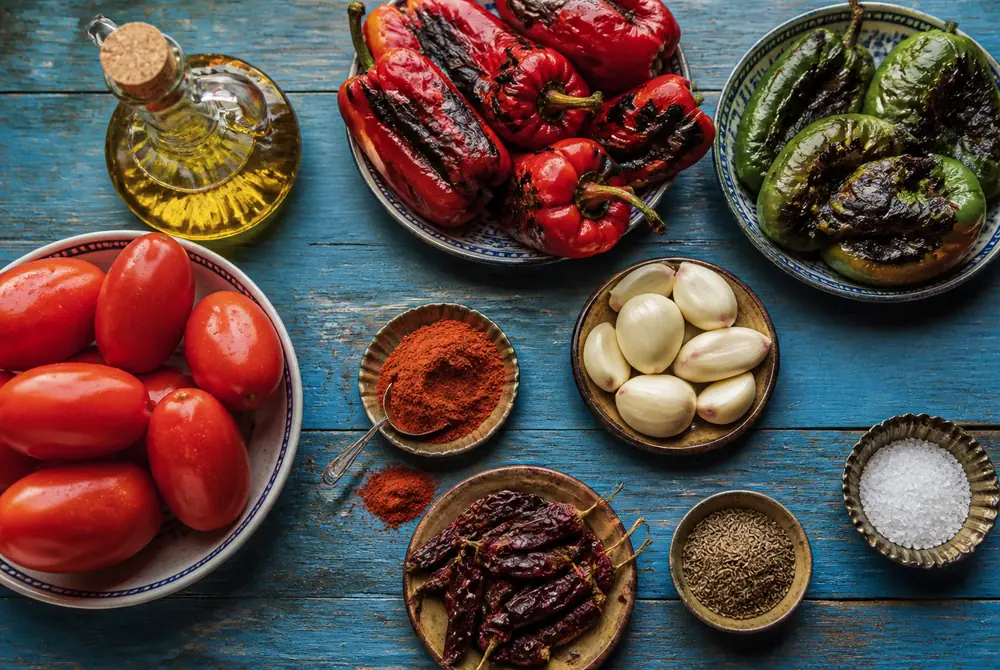
- 3 pounds ripe plum or Roma tomatoes — meaty, low in water, and the whole backbone of the dish. Out of season, good canned whole peeled tomatoes genuinely outperform pale winter fresh ones.
- 4 large red bell peppers — roasted and peeled. Red, not green: you want sweetness and body.
- 1 to 2 hot peppers such as jalapeño or a fresh red chili — optional but traditional in many families. Matbucha ranges from mild to fiery depending on whose grandmother made it.
- 8 to 10 garlic cloves, thinly sliced — a lot by American standards, and it mellows completely over the long cook.
- 1/2 cup extra virgin olive oil — this is a cooking fat and a texture ingredient, not a garnish. Do not cut it in half.
- 1 tablespoon sweet paprika — added late so it blooms in oil rather than scorching.
- 1 teaspoon kosher salt, plus more to taste
- Optional: 1 teaspoon ground cumin, a pinch of sugar if the tomatoes are tart, a squeeze of lemon at the end
That is the entire list. There is no stock, no onion in the classic Moroccan version, and no tomato paste — the concentration comes from time, not shortcuts. Cooks who add onion are not wrong, exactly, but the result reads sweeter and softer than the version most Moroccan families would recognize.
Step-by-Step: How to Make Matbucha
Plan on about two hours, most of it unattended. Use a wide pan rather than a tall pot — surface area is what lets moisture escape and the flavors concentrate.
- Roast the peppers. Char the bell peppers and hot peppers directly over a gas flame, under a broiler, or on a grill until the skins are blackened and blistered all over, about 12 to 15 minutes with regular turning.
- Steam and peel. Transfer the hot peppers to a bowl, cover tightly, and let them sit 15 minutes. The trapped steam loosens the skins; they should slip off with your fingers. Do not rinse them under water — you will wash away the smoke you just worked for. Remove seeds and stems, then tear the flesh into wide strips.
- Peel the tomatoes. Score a shallow X in the bottom of each tomato, drop them into boiling water for 45 seconds, then into ice water. The skins will slide off. Halve them, scoop out most of the seeds and watery pulp, and chop the flesh roughly.
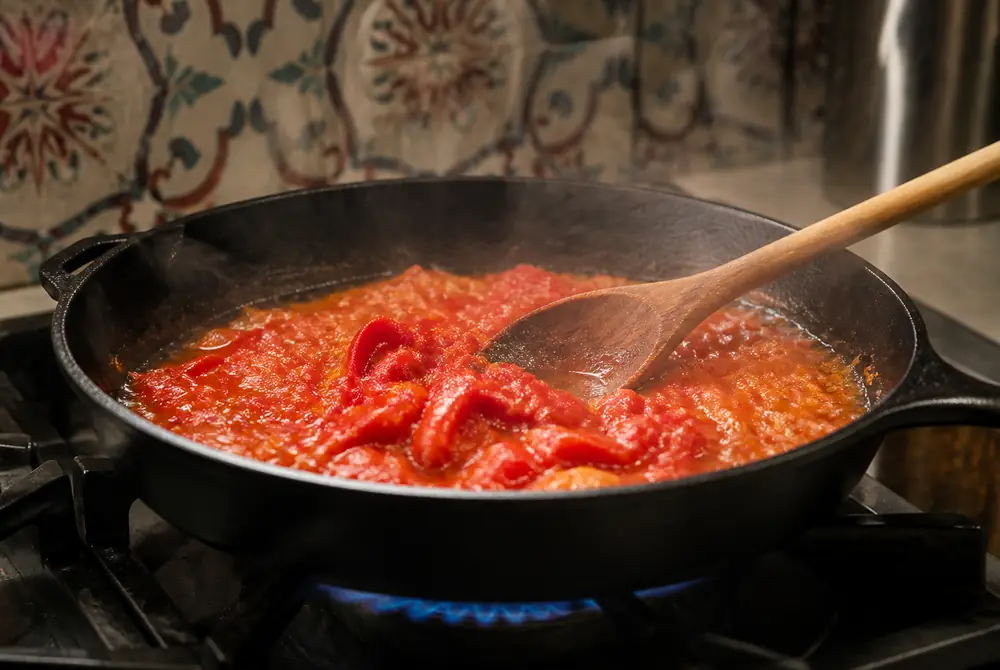
- Start the cook. Put the chopped tomatoes in a wide skillet or braiser over medium heat with the salt and no oil yet. Let them bubble uncovered, stirring occasionally, for 30 to 40 minutes until most of the free liquid has evaporated and the mixture looks like a rough, dry jam.
- Add peppers, garlic, and oil. Stir in the pepper strips, sliced garlic, and the olive oil. Reduce the heat to low. This is where the character of the dish is built.
- Cook it down. Continue at a lazy simmer for 45 to 60 minutes, stirring every ten minutes or so and scraping the bottom. The mixture will darken from bright red to a deep brick color and the oil will separate and pool at the edges — that pooling is the signal you are looking for.
- Add paprika. Stir in the paprika and optional cumin in the last five minutes, off direct high heat, so the spice blooms in the oil without turning bitter.
- Rest and adjust. Take the pan off the heat and let the matbucha cool to room temperature. Taste and adjust salt, adding a pinch of sugar if the tomatoes were sharp, or a squeeze of lemon if it tastes flat.
Expert Tips for Better Matbucha
- Cook the tomatoes down before the oil goes in. Adding the oil at the start means you are frying rather than reducing, and the finished texture comes out greasy instead of jammy.
- Slice the garlic instead of mincing it. Over an hour of low cooking, slices turn silky and sweet while mince tends to disappear or catch and burn.
- Use a wide pan. A 12-inch skillet will get you there in half the time a narrow saucepan will.
- Salt early, taste late. Salt at the beginning helps the tomatoes release water; final seasoning belongs at room temperature, since cold food always reads less seasoned.
- Make it a day ahead. Matbucha is genuinely better after 24 hours in the refrigerator, and better still on day three. This is not a dish that suffers from planning.
- Freeze in flat portions. Two-cup bags frozen flat thaw in an hour and lose almost nothing.
Common Mistakes to Avoid
- Rushing the reduction. Undercooked matbucha tastes like chunky tomato sauce. The whole point is concentration, and there is no way to hurry it.
- Skipping the pepper roast. Raw peppers simmered in the pot give you sweetness but none of the smoke, and smoke is half the flavor.
- Rinsing charred peppers under the tap. It is faster, and it costs you exactly the flavor you were building.
- Leaving the tomato seeds and pulp in. They add water you then have to boil off, which means more cooking time and a duller final flavor.
- Adding paprika at the start. An hour over heat turns paprika bitter and muddy-brown. Late is right.
- Serving it hot. Matbucha is a cold or room-temperature dish, and the flavors are simply not there straight off the stove.
How to Serve and Store It
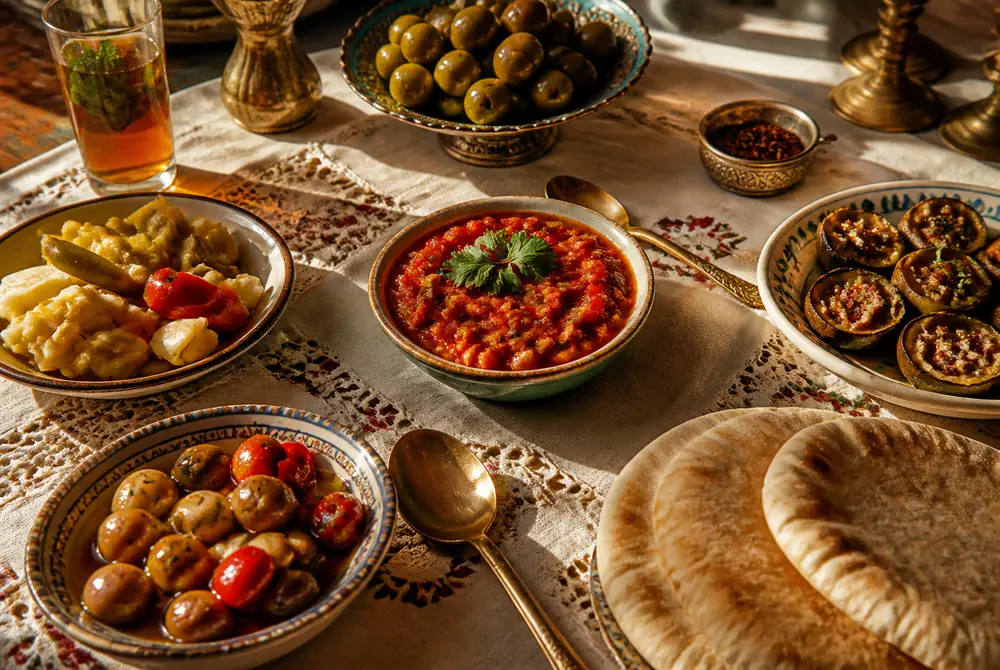
In its natural habitat, matbucha arrives as part of a crowded table of salatim — pickles, olives, roasted eggplant, chopped salad — with warm bread for scooping. That is still the best way to eat it. Beyond the mezze board, it works spooned over eggs at brunch, stirred into rice, folded into a sandwich with hard-boiled egg and tuna, or used as the base for poaching eggs in a shakshuka-adjacent breakfast.
Stored in a clean jar with a thin layer of olive oil poured over the top, matbucha keeps in the refrigerator for about ten days. In the freezer it holds for three months with no meaningful loss in texture. Bring it back to room temperature before serving — cold from the fridge, the olive oil stiffens and the flavors go quiet.
Nutrition Notes
Matbucha is essentially cooked tomatoes and peppers in olive oil, which puts it squarely in the Mediterranean-diet column. Cooking tomatoes increases the bioavailability of lycopene, the carotenoid responsible for their red color, and the presence of fat in the pan helps the body absorb it — a well-documented pairing effect that makes the generous olive oil in this recipe more than a texture decision. Red bell peppers, meanwhile, are among the densest common sources of vitamin C, though a long cook does reduce that.
A quarter-cup serving runs roughly 90 to 110 calories, most of it from olive oil, with meaningful fiber and no cholesterol. It is naturally pareve, so it can be served alongside either a meat or a dairy meal under kosher dietary law — one reason it appears on so many Shabbat tables regardless of what the main course happens to be.
Conclusion
Matbucha is a lesson in what patience does to cheap ingredients. Nothing in the pot costs much, nothing about the method is technically demanding, and yet the finished dish carries a depth that no fast tomato preparation can touch. It is also a small piece of a much larger story — a Moroccan Jewish community that carried its kitchen across the Mediterranean and, in doing so, reshaped what the Israeli and now the American Jewish table looks like.
Make a double batch. Give the pot the two hours it asks for. Then put it in the refrigerator, forget about it until Saturday, and watch how quickly it disappears.
Key Takeaways
- Matbucha is a slow-cooked Moroccan Jewish salad of tomatoes, roasted red peppers, garlic, and paprika, served cold or at room temperature.
- The defining technique is reduction: cook the tomatoes down before adding oil, then simmer low for about an hour until the oil separates.
- Roast and peel the peppers over an open flame and never rinse off the char — the smoke is half the flavor.
- Add paprika in the final five minutes so it blooms in oil instead of turning bitter.
- The dish is naturally pareve, vegan, and gluten-free, and it tastes better on day two or three than the day it is made.
- It keeps ten days refrigerated under a layer of olive oil and freezes well for three months.
Frequently Asked Questions
What does matbucha taste like?
Deeply sweet-savory and slightly smoky, with a jammy texture and a garlicky, paprika-warm finish. Heat level varies by family — some versions are mild, others are genuinely spicy from added chilies.
Can I use canned tomatoes for matbucha?
Yes, and outside of tomato season you probably should. Use good-quality whole peeled canned tomatoes, drain off the packing liquid, and chop them. Skip the peeling and blanching steps entirely.
Is matbucha the same as shakshuka?
No, though they are cousins. Matbucha is a thick cooked salad served cold; shakshuka is a hot skillet dish with eggs poached in a looser tomato and pepper sauce. Matbucha can be thinned with a little water and used as a shakshuka base.
Is matbucha kosher and pareve?
Yes. Made with vegetables, olive oil, and spices, matbucha contains no meat or dairy, so it is pareve and can be served with either type of meal. As with any recipe, verify that individual products carry reliable kosher certification.
How long does matbucha last in the fridge?
About ten days in a clean sealed jar with a thin layer of olive oil poured over the surface. It also freezes well for up to three months — freeze it flat in portion-sized bags for fast thawing.
Loved this recipe?
Share it with your family, leave a comment, and explore more traditional and modern Jewish dishes on JewishCuisine.
Explore more Traditional recipes