Jewish Chopped Liver: The Deli Classic Worth Making at Home
There is a joke that has been told in Jewish homes for about a hundred years: “What am I, chopped liver?” You say it when someone ignores you. It only works as a joke because chopped liver was always on the table. It sat on every Friday night tray and every bar mitzvah buffet. People expected it, and nobody made a fuss over it.
That ordinariness hides how good the dish can be. Made well, chopped liver is deep, savory, a little sweet from the onions, and rich in a way no store-bought spread can match. Made badly, it is gray, grainy, and bitter. The gap between the two comes down to a few choices: how you cook the livers, how long you cook the onions, and what fat you use. This guide covers all three, along with the history, the kosher rules, and the mistakes that ruin a batch.
Table of Contents
- What Chopped Liver Is
- Historical and Cultural Context
- Why Chopped Liver Is Trending Again
- Ingredients and What Each One Does
- Step-by-Step: Making Chopped Liver
- Expert Tips
- Common Mistakes to Avoid
- Serving and Storing
- Frequently Asked Questions
- Key Takeaways
- Conclusion
What Chopped Liver Is
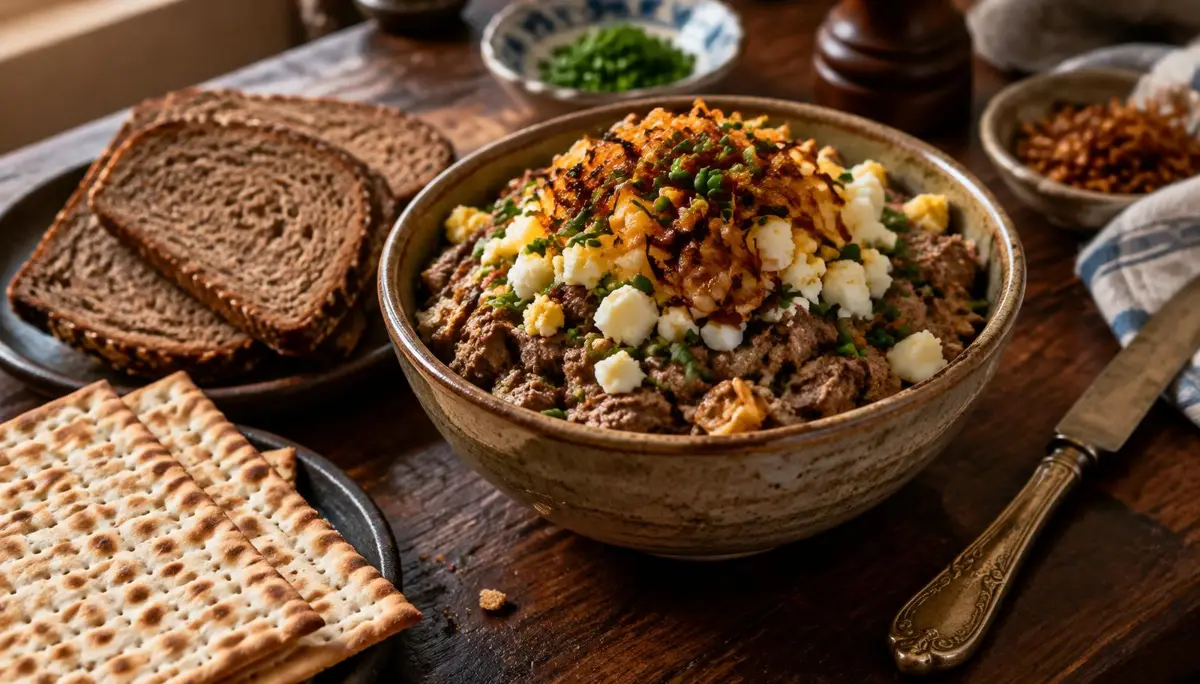
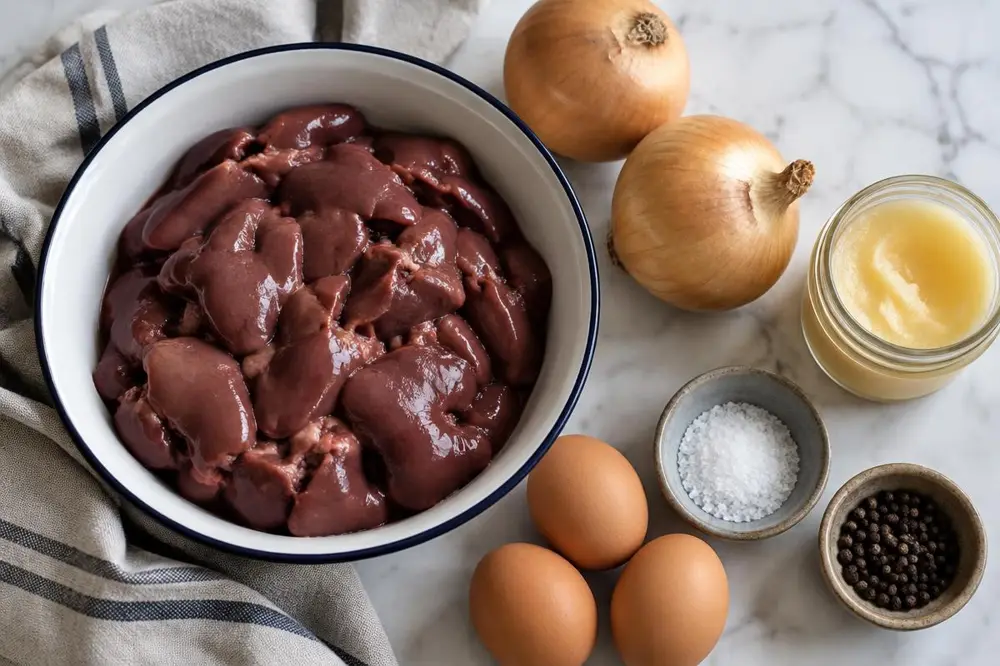
Chopped liver, called gehakte leber in Yiddish, is a coarse spread made from cooked chicken livers (sometimes beef or a mix), onions fried in fat until deeply browned, and hard-boiled eggs. Everything is chopped or ground together and seasoned well with salt and black pepper. The texture should be spreadable but still a little rough. It is not a silky French pâté, and it is not supposed to be.
The other thing that sets it apart from pâté is the fat. French pâté relies on butter and cream. Jewish dietary law forbids mixing meat and dairy, so Ashkenazi cooks used schmaltz instead. Schmaltz is rendered chicken fat, often cooked with onions until the solids turn into crunchy gribenes. That one swap shapes the whole flavor of the dish: savory and roasted, with no buttery sweetness.
Historical and Cultural Context
Chopped liver comes out of the poverty of Eastern European Jewish life. In the shtetls of Poland, Lithuania, and Ukraine, a chicken was precious. Many families ate one only for Shabbat, and nothing from it went to waste. The fat was rendered into schmaltz. The neck was stuffed. The feet went into soup. The liver, too small to feed a family alone, was chopped with eggs and onions so that it could stretch into a spread for several people.
Geese mattered too. In parts of Central Europe, Jewish households raised and fattened geese for their fat, and goose liver dishes were common long before chicken took over. Some food historians link the Jewish taste for liver spreads to that goose tradition in Alsace, Bohemia, and Hungary.
Kashrut shaped the dish in a second way. Under Jewish law, liver is so full of blood that soaking and salting, the usual way of koshering meat, is not enough. Liver must be broiled over an open flame until it is cooked through and the blood is drawn out. Only after that step can it be sautéed or chopped. So the slightly charred, firm-cooked character of traditional chopped liver is not just a matter of taste. It is a matter of religious law.
Nothing from the Shabbat chicken was wasted. The liver was too small to feed a family, so it was chopped with eggs and onions until it could feed everyone.
When millions of Ashkenazi Jews came to America between 1880 and 1924, chopped liver came with them. It became a standard of the Jewish delicatessen on the Lower East Side and later in every big city with a Jewish community. Delis sold it by the pound, piled it on rye, and served scoops of it next to pickles. Catskills resorts put it out in molds shaped like fish or hearts for weddings. By the mid-twentieth century it was so common that it turned into a punchline.
Why Chopped Liver Is Trending Again
For a while chopped liver looked like a dish that would fade out with the older generation. Cholesterol worries in the 1980s and 1990s pushed it off many holiday tables. Delis closed. Younger cooks reached for hummus instead.
That has changed. Three trends have brought it back. The first is nose-to-tail cooking. Chefs and home cooks now see organ meats as thrifty, sustainable, and full of flavor, and chicken livers are among the cheapest proteins at any butcher. The second is the revival of the Jewish deli. A new generation of delis in Brooklyn, Los Angeles, Chicago, and London is cooking the old menu with care, and chopped liver is often the dish people talk about most. The third is nutrition. Liver is one of the most nutrient-dense foods there is, packed with vitamin A, vitamin B12, folate, and iron, which has made it popular with people following whole-food diets.
Social media helps too. Short videos of onions turning dark and glossy in schmaltz get a lot of attention, and grandparents' recipe cards have become a genre of their own. Chopped liver fits that mood well: it is old, personal, and a little unfashionable, which is part of why people like it now.
Ingredients and What Each One Does
This recipe makes about 3 cups, enough for 8 to 10 people as a starter.
- 1 pound chicken livers: Look for plump, deep red-brown livers with no green spots. Green means bile, which tastes bitter.
- 3 large yellow onions: They should equal or outweigh the livers. Their sweetness balances the iron taste of the liver.
- 4 tablespoons schmaltz, divided: Rendered chicken fat gives the traditional flavor. Olive oil or a neutral oil works, but the result is flatter.
- 3 large eggs, hard-boiled: They add body, soften the liver flavor, and make the mixture go further.
- 1 to 1½ teaspoons kosher salt: Liver and eggs both need more salt than you expect.
- ½ teaspoon freshly ground black pepper: Coarse and generous.
- Optional: 1 tablespoon gribenes, a splash of sweet kosher wine or brandy, or a pinch of sugar for the onions.
A Note on Kosher Liver
If you keep kosher, buy livers that have already been broiled and koshered by your butcher, which many kosher shops sell, or broil them yourself as described below before any other cooking. Most supermarket “kosher” chicken livers are sold raw and still need this step. If you are unsure, ask your butcher or your local rabbi. The OU and Star-K both publish clear guidance on broiling liver at home.
Step-by-Step: Making Chopped Liver
1. Hard-boil the eggs
Place the eggs in a pot, cover with cold water, and bring to a boil. Turn off the heat, cover, and leave them for 11 minutes. Move them to ice water, then peel. Set one egg aside for garnish if you like.
2. Trim the livers
Pat the livers dry. Cut away any connective tissue, fat, and any green patches. Separate the lobes so they are roughly the same size.
3. Broil the livers
Heat your broiler to high. Spread the livers on a rack set over a foil-lined sheet pan, sprinkle with coarse salt, and broil about 4 inches from the heat for 4 to 5 minutes per side. They should be firm and browned outside and fully cooked through, with no pink. For kosher preparation, the liver must be cut or pierced first, salted, broiled until cooked through, and then rinsed three times. If you do not keep kosher, you can instead sauté the livers in schmaltz over medium-high heat for 3 to 4 minutes per side.
4. Cook the onions slowly
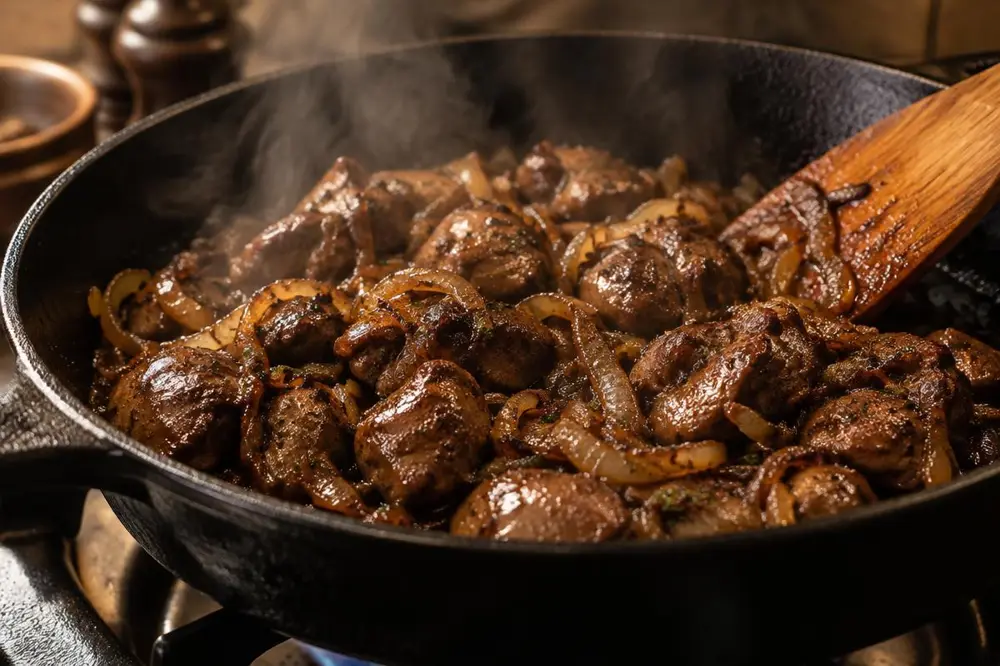
This is the step that matters most. Slice the onions thinly. Melt 3 tablespoons of schmaltz in a large skillet over medium heat, add the onions and a pinch of salt, and cook, stirring every few minutes, for 35 to 45 minutes. Lower the heat if they brown too fast. You want them a deep, glossy brown, soft, and sweet, not just golden.
5. Bring livers and onions together
Add the broiled livers to the onions for 2 to 3 minutes so they warm through and pick up the fat. If you are using wine or brandy, add it now and let it cook off completely. Take the pan off the heat and let everything cool for 10 minutes.
6. Chop or grind
The old way is a wooden bowl and a curved hand chopper called a hackmesser. A meat grinder with a medium plate is the next best thing and gives the classic deli texture. With a food processor, pulse in short bursts, about 8 to 12 times, scraping down the bowl. Add the eggs at the end and pulse just 3 or 4 more times. Stop while the mix is still a bit rough.
7. Season and chill
Fold in the last tablespoon of schmaltz, the salt, and the pepper. Taste. It should taste a little too salty while it is warm, because cold food tastes less seasoned. Pack it into a bowl, press plastic wrap right on the surface, and refrigerate for at least 2 hours so the flavors settle and the texture firms up.
Expert Tips
- Use as much onion as liver, or more. Most bland chopped liver has too little onion.
- Make your own schmaltz from chicken skin and fat and save the gribenes to scatter on top. It costs almost nothing. See our guide to schmaltz and gribenes.
- Grind on the coarse side. You want small, distinct bits, not a paste.
- Season cold, not just warm. Taste again after chilling and adjust.
- Soak livers in milk only if you do not keep kosher. It mellows the flavor, but for a kosher kitchen, broiling already does much of that work.
- Let it come to cool room temperature for 15 minutes before serving. Straight from the fridge, the fat is too firm and the flavor muted.
Common Mistakes to Avoid
- Overcooking the livers until they are dry and chalky. Cook them just until no pink remains.
- Rushing the onions. Ten minutes of high heat gives you scorched edges and raw centers.
- Leaving green bile spots on the livers. One spot can make a whole batch bitter.
- Blending to a puree. A food processor left running turns chopped liver into gray paste.
- Under-salting. Liver and eggs both soak up salt, and chilling dulls it further.
- Skipping the broiling step in a kosher kitchen. Liver cannot be koshered by salting alone.
Serving and Storing
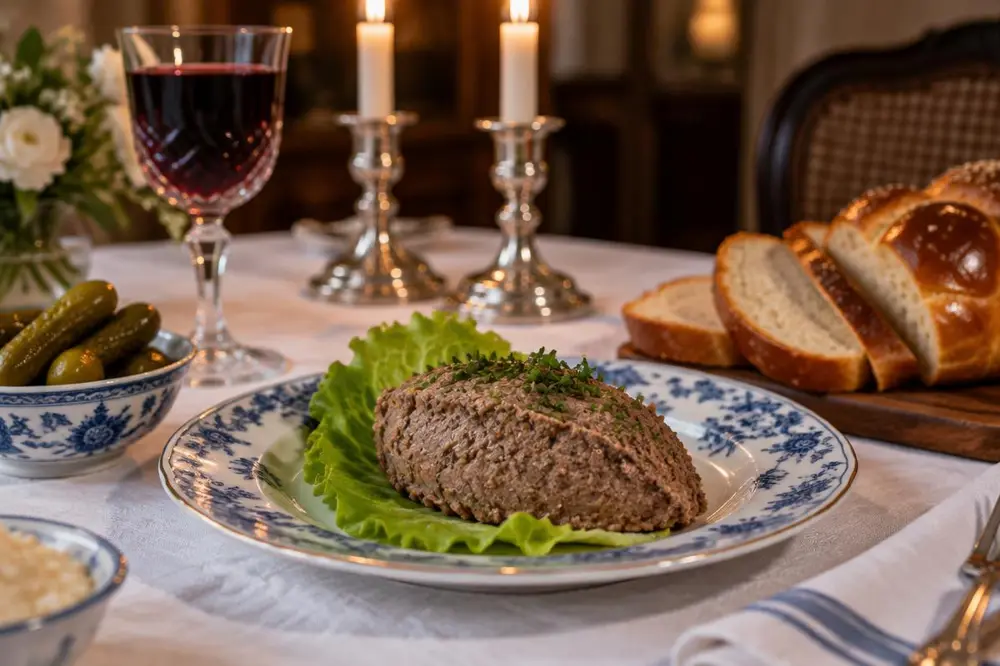
Serve chopped liver on a lettuce leaf with a scoop of grated egg on top, alongside rye bread, toasted challah, or matzo. Sour pickles, sliced radishes, and red onion cut the richness. At a Shabbat dinner it goes out as a first course before the soup. On Passover, spread it on matzo and you have a classic seder-night starter. At a deli, it goes into a sandwich on rye, sometimes stacked with pastrami or corned beef.
Store chopped liver in an airtight container with plastic pressed against the surface for up to 3 days in the refrigerator. A thin layer of melted schmaltz on top helps keep it from darkening. You can freeze it for up to 2 months, though the texture gets a little looser after thawing. Thaw it overnight in the refrigerator and stir well before serving. Because it contains cooked liver and eggs, do not leave it out for more than 2 hours, as USDA food safety guidelines advise.
Conclusion
Chopped liver started as a way to stretch the smallest part of a Shabbat chicken, and it became one of the dishes people remember most from Jewish tables. Its secrets are simple: broil or sauté the livers just until done, give the onions the time they need, use real schmaltz, and stop chopping before it turns to paste. Make a bowl this Friday, put it out with challah and pickles, and see how fast it disappears. Nobody at your table will feel like chopped liver.
Key Takeaways
- Chopped liver (gehakte leber) is an Ashkenazi spread of chicken livers, caramelized onions, hard-boiled eggs, and schmaltz.
- Schmaltz replaces butter because kosher law forbids mixing meat and dairy, which gives the dish its savory, roasted flavor.
- In a kosher kitchen, liver must be broiled over a flame until cooked through before any other cooking.
- Slow-cooked onions, at least 35 minutes, matter more to the final flavor than any other step.
- Chop or pulse to a coarse texture, season boldly, and chill for at least 2 hours before serving.
- It keeps 3 days refrigerated and is a natural Shabbat, Passover, or deli-sandwich starter.
Frequently Asked Questions
What is Jewish chopped liver made of?
Traditional chopped liver is made from cooked chicken livers, onions slowly fried in schmaltz (rendered chicken fat), hard-boiled eggs, salt, and black pepper. Some families add beef liver, gribenes, or a splash of sweet wine.
Is chopped liver kosher?
It can be, but liver has special rules. Because it holds so much blood, it must be broiled over an open flame until fully cooked and then rinsed before being chopped or sautéed. Many kosher butchers sell pre-broiled livers to make this easier.
How is chopped liver different from pâté?
French pâté is usually smooth and made with butter or cream. Jewish chopped liver uses schmaltz instead of dairy to keep it kosher, includes hard-boiled eggs, and has a coarser, chunkier texture.
Why does my chopped liver taste bitter?
Bitterness usually comes from green bile spots left on the livers, overcooked livers, or onions that were scorched instead of slowly caramelized. Trim carefully and cook the onions low and slow.
How long does chopped liver last?
Up to 3 days in the refrigerator with plastic wrap pressed on the surface, or up to 2 months in the freezer. Thaw overnight in the fridge and stir before serving.
Loved this recipe?
Share it with your family, leave a comment, and explore more traditional and modern Jewish dishes on JewishCuisine.
Explore more Traditional recipes