Hamantaschen: The Three-Cornered Purim Cookie Everyone Loves to Fill
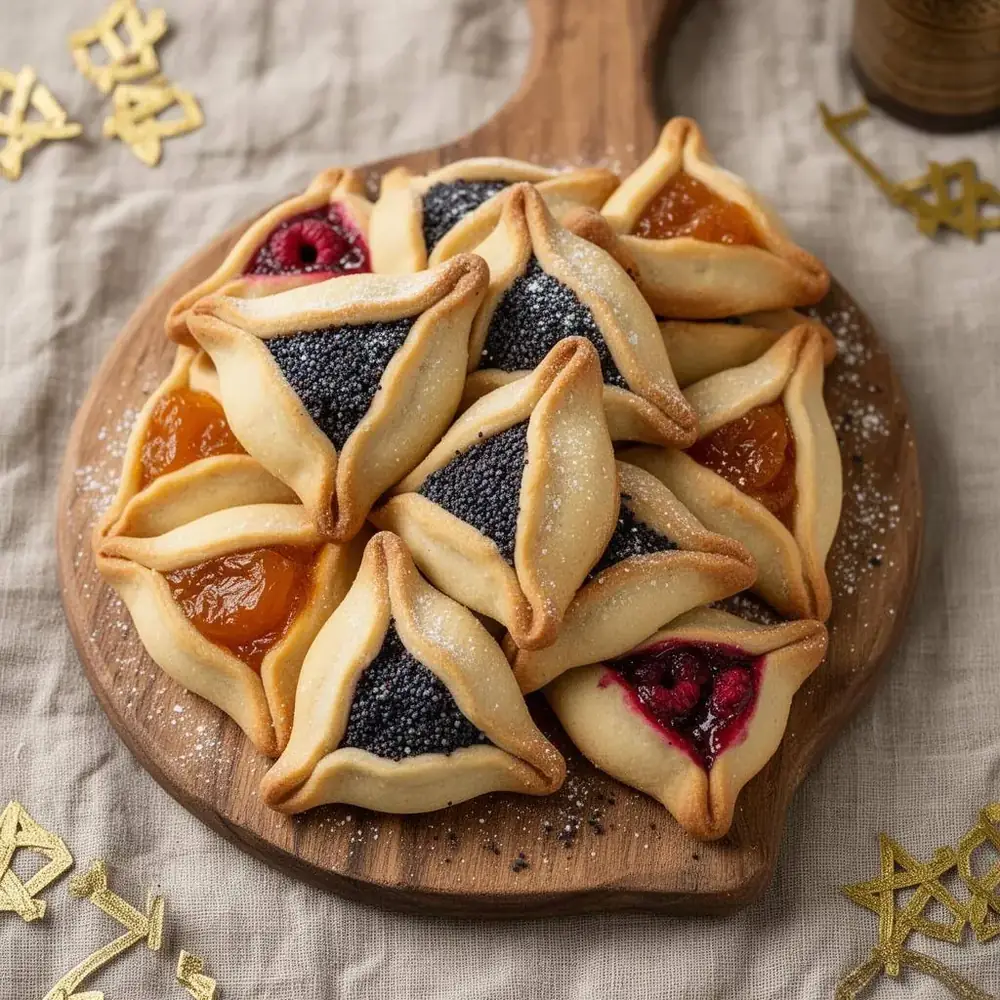
Few cookies tell a story as completely as the hamantaschen. Three corners pinched up around a glossy pool of filling, baked until the edges turn golden and the dough goes tender and short — it is a cookie built for a holiday of costumes, noisemakers, and unapologetic joy. Every spring, as Purim approaches, Jewish kitchens around the world fill with the smell of butter, citrus, and poppy seed, and bakers settle in for the happy, slightly maddening ritual of folding hundreds of little triangles. This is the only hamantaschen recipe you'll need: a reliable dough, a lineup of classic and modern fillings, and the folding technique that keeps them from springing open in the oven.
If you've ever pulled a tray of hamantaschen from the oven only to find flat, unfolded discs swimming in escaped jam, you are in good company — it happens to nearly everyone the first time. The good news is that leak-proof, picture-perfect hamantaschen come down to a handful of small, learnable habits: a dough that's properly chilled, fillings that are thick rather than runny, and a pinch-and-seal method that actually holds. Master those, and you'll be turning out bakery-worthy cookies that taste like the best memories of the holiday.
What Are Hamantaschen?
Hamantaschen (pronounced HUH-men-tash-en; the singular is hamantasch) are triangular filled cookies eaten on Purim, the joyous Jewish holiday that celebrates the rescue of the Jews of ancient Persia from a plot to destroy them. The name is most often translated from Yiddish as “Haman's pockets” — Haman being the villain of the Purim story — though many also connect the cookie's three corners to his three-cornered hat. In Hebrew they're called oznei Haman, “Haman's ears,” a slightly more gruesome image for a very sweet treat.
Whatever you call them, the formula is consistent: a rich, lightly sweet cookie dough rolled thin, cut into circles, topped with a spoonful of filling, and folded up at three points into the iconic triangle. The dough is somewhere between a sugar cookie and a tender shortbread — sturdy enough to hold its shape, soft enough to melt in your mouth. The fillings are where tradition meets personality, ranging from the deeply old-school poppy seed to thoroughly modern chocolate, halva, and dulce de leche.
A Little Purim History
Purim commemorates the events of the Book of Esther, in which Queen Esther and her cousin Mordechai foil the genocidal scheme of Haman, advisor to the Persian king Ahasuerus. It's a holiday of reversal and relief — of mourning turned to gladness — and Jews mark it with costumes, the noisy reading of the Megillah (the Scroll of Esther), charity to the poor, festive meals, and gifts of food to friends and neighbors known as mishloach manot. Hamantaschen are the holiday's signature edible, baked by the dozen and packed into gift baskets across the world.
The cookie itself likely descends from the Central European mohntaschen — “poppy seed pockets” — a filled pastry popular among German and Eastern European bakers. As the treat became attached to Purim, the similarity between mohntaschen and “Haman-taschen” gave it a fittingly festive new meaning, and the three-cornered shape cemented its connection to the holiday's villain. Over centuries and across continents, Jewish bakers adapted the cookie to local tastes, but its role never changed: a small, sweet symbol of survival and celebration.
More than any other Purim food, the hamantasch turns a story of danger into a story of delight — we quite literally make the villain into something sweet, share it generously, and eat it with joy.
Ingredients
For the Dough
- 3 cups (375g) all-purpose flour, plus more for rolling
- 1 teaspoon baking powder
- ¼ teaspoon salt
- ¾ cup (170g) unsalted butter, softened (or margarine for a pareve version)
- ¾ cup (150g) granulated sugar
- 2 large eggs
- 1 teaspoon pure vanilla extract
- Zest of 1 orange or lemon (optional, but it makes the dough sing)
- 2 tablespoons orange juice or milk, as needed to bring the dough together
Classic Filling Options
- Poppy seed (mohn) — the most traditional; use canned poppy seed filling or make your own with ground poppy seeds, milk, honey, and a little lemon
- Apricot, raspberry, or prune (lekvar) jam — thick, low-moisture preserves work best
- Chocolate — a firm ganache or thick chocolate spread (not warm, pourable chocolate)
- Halva, date paste, dulce de leche, or sweetened cream cheese for modern twists
For Finishing
- 1 egg beaten with 1 teaspoon water, for an egg wash that gives a glossy, golden finish
- Powdered sugar for dusting after baking (optional)
Step-by-Step Instructions
Step 1: Make the Dough
- Whisk the flour, baking powder, and salt together in a bowl and set aside.
- In a large bowl, beat the softened butter and sugar until light and fluffy, about 2–3 minutes.
- Beat in the eggs one at a time, then the vanilla and citrus zest.
- Add the flour mixture and mix just until a soft dough forms. If it's dry and crumbly, add orange juice or milk a tablespoon at a time; if sticky, add a little flour.
- Divide the dough in half, flatten into discs, wrap well, and chill for at least 1 hour (or up to 2 days). Cold dough is the single biggest factor in clean, leak-proof folding.
Step 2: Roll, Cut & Fill
- Preheat the oven to 350°F (175°C) and line two baking sheets with parchment.
- Working with one disc at a time (keep the other chilled), roll the dough on a lightly floured surface to about ¼ inch (6mm) thick — not too thin, or the corners won't hold.
- Cut out circles with a 3-inch (7.5cm) round cutter or a drinking glass. Re-roll scraps once.
- Place a scant teaspoon of thick filling in the center of each circle. Resist overfilling — it's the number-one cause of leaks and blowouts.
Step 3: Fold the Triangles
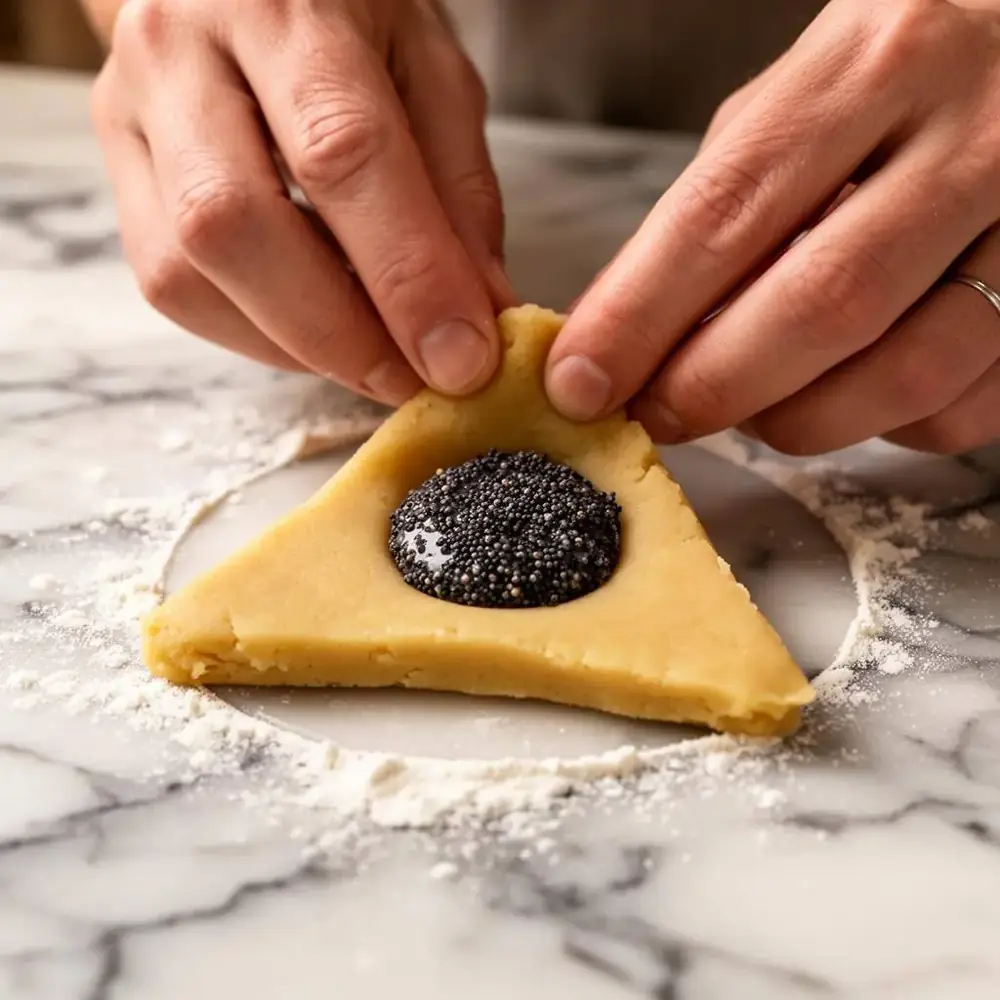
- Imagine the circle as a triangle with three sides. Fold one edge up over the filling, then a second, then a third, so the three folds overlap at the corners and leave a small window of filling in the center.
- Pinch each corner firmly — really pinch, don't just press — so the seams lock together. A tiny dab of egg wash or water at each corner acts like glue.
- Aim for the filling to peek through the center but not bulge over the folds.
- For extra insurance, chill the shaped cookies on the tray in the freezer for 10–15 minutes before baking so the corners set before the butter melts.
Step 4: Egg Wash & Bake
- Brush the dough (not the filling) with egg wash for a glossy, golden finish.
- Bake at 350°F (175°C) for 12–15 minutes, until the edges are lightly golden. They firm up as they cool, so don't overbake.
- Cool on the tray for 5 minutes, then transfer to a rack. Dust with powdered sugar if you like.
Keep the dough cold and the filling thick. Warm dough spreads and unfolds; runny filling boils and pushes the corners open. Get those two things right and your hamantaschen will hold their shape every time.

How to Keep Hamantaschen From Opening
The eternal hamantaschen struggle is the cookie that unfolds in the oven, leaving a flat disc and a puddle of filling. Here's how to win that battle for good:
- Chill twice — once before rolling, and again after shaping. Cold corners set before they can relax open.
- Pinch, don't fold-and-pray. Firmly compress each corner so the seams fuse; a touch of egg wash or water helps them stick.
- Use thick fillings. Canned poppy seed, lekvar, firm ganache, and low-moisture jams behave; loose jam and warm chocolate don't.
- Don't overfill — a scant teaspoon is plenty. More filling means more steam pressure forcing the corners apart.
- Roll the dough thick enough (about ¼ inch). Paper-thin dough has nothing to grip when you pinch.
Filling Ideas, Classic to Modern
- Traditional: poppy seed (mohn), prune lekvar, apricot, raspberry, and date paste.
- Chocolate lover's: thick chocolate ganache, Nutella-style spread, or chocolate chips mixed with a little cocoa.
- Middle Eastern: halva, tahini-date, or pistachio cream nod to Israeli bakeries.
- Dessert-forward: dulce de leche, sweetened cream cheese, or cookie butter.
- Savory experiments: pizza-style with tomato and cheese, or za'atar and feta for a Purim party twist.
Make-Ahead, Storage & Freezing
- Make-ahead dough: refrigerate up to 2 days or freeze up to 2 months; thaw in the fridge before rolling.
- Freeze unbaked: shape and freeze the cookies on a tray, then bag them — bake straight from frozen, adding a minute or two.
- Store baked: keep in an airtight container at room temperature for up to 5 days; jam-filled cookies are best within 2–3 days.
- Freeze baked: freeze in a single layer, then stack with parchment between layers; dust with fresh powdered sugar after thawing.
Common Mistakes to Avoid
- Skipping the chill — warm dough is the top reason hamantaschen spread and open.
- Overfilling, which forces the corners apart and creates leaks.
- Using runny jam or warm chocolate that boils over during baking.
- Rolling the dough too thin, leaving nothing to pinch and grip.
- Overbaking — pull them when the edges are just golden; they crisp as they cool.
Once you've got the method down, hamantaschen become a yearly tradition you'll actually look forward to — a kitchen project for kids and grandparents alike, an afternoon of folding and tasting, and a tin of beautiful triangles to share. Tuck a few into a mishloach manot basket alongside other treats, and you've captured the whole spirit of Purim: a little sweetness, generously shared.
Key Takeaways
- Hamantaschen are triangular filled cookies eaten on Purim, symbolizing the holiday's villain, Haman.
- Cold dough plus thick filling is the secret to leak-proof, picture-perfect triangles.
- Pinch each corner firmly (a dab of egg wash helps) and don't overfill — a scant teaspoon is plenty.
- Made with butter they're dairy; swap in margarine and orange juice for a pareve, mishloach-manot-friendly batch.
Frequently Asked Questions
Why do my hamantaschen open up in the oven?
Almost always it's warm dough, too much filling, or runny filling. Chill the dough before and after shaping, pinch the corners firmly (a dab of egg wash helps them stick), use thick fillings, and add only a scant teaspoon per cookie.
What is the most traditional hamantaschen filling?
Poppy seed (mohn) is the oldest and most traditional filling, followed by prune lekvar and apricot. Modern bakers also love raspberry, chocolate, halva, and dulce de leche — all delicious in the same dough.
Can I make hamantaschen pareve or ahead of time?
Yes. Swap the butter for margarine and use orange juice instead of milk for a pareve batch suitable after meat meals. You can refrigerate or freeze the dough, and even freeze shaped cookies raw to bake straight from frozen.
Loved this recipe?
Share it with your family, leave a comment, and explore more traditional and modern Jewish dishes on JewishCuisine.
Explore more Holidays recipes